
New Zealand Institute of Economic Research (Inc)
Media Release, 10 am Monday, 31 August 2026
For immediate release
The NZIER Monetary Policy Shadow Board recommends that the Reserve Bank of New Zealand (RBNZ) continue to increase the OCR in the upcoming September Monetary Policy Statement, with just over half of the Shadow Board members recommending a 25-basis-point increase to bring the OCR to 2.75 percent. This reflects the view that the OCR needs to continue on its path of returning to neutral levels, given that inflation remains high. However, some considered it appropriate for the RBNZ to keep the OCR on hold at 2.50 percent, given that activity in the New Zealand economy remains subdued and inflation expectations measures in the RBNZ Survey of Expectations have eased recently.
Regarding where the OCR should be in a year’s time, Shadow Board members agree that the RBNZ should continue to increase the OCR over the coming year, with views centring on 3 to 3.25 percent. There is a consensus amongst the Shadow Board that the RBNZ should continue to raise the OCR towards neutral levels over time. Several members highlighted their support for gradual increases in the OCR over the coming year, noting that the RBNZ needs to maintain an appropriate balance between controlling inflation and supporting the economy.
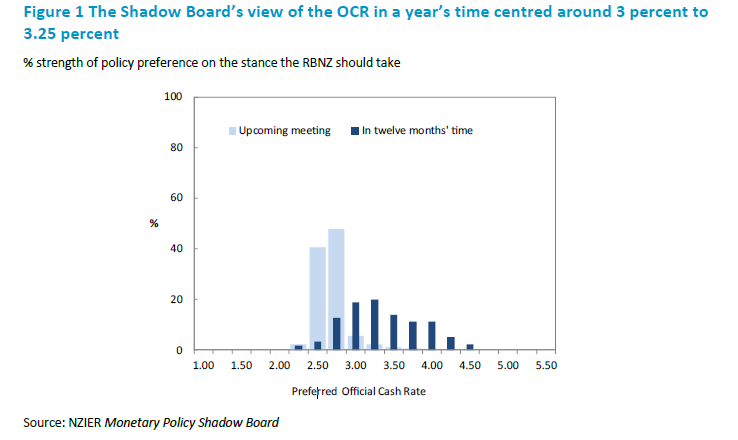
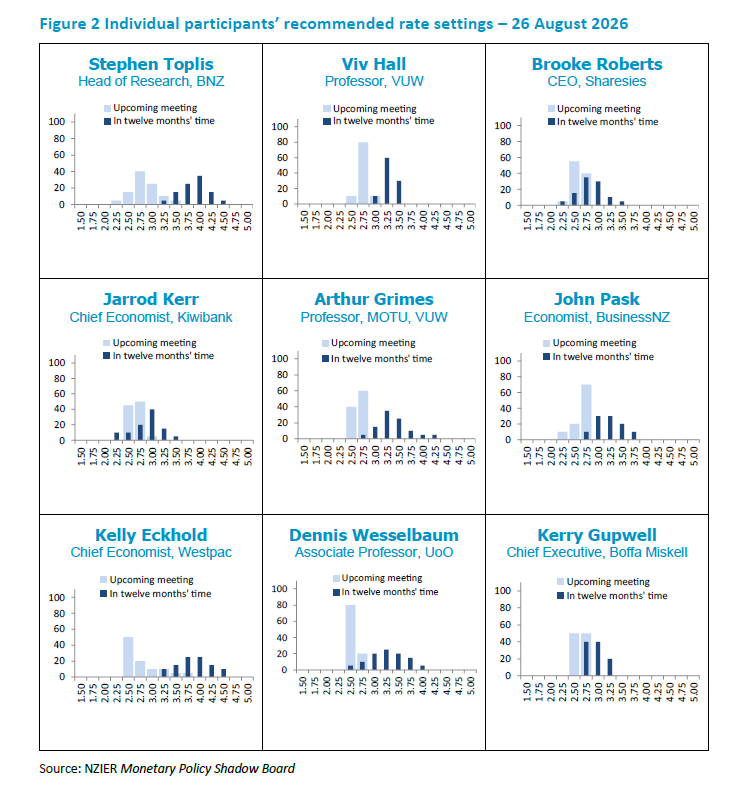
Table 1 Participant comments
Participants' comments are optional
|
Stephen Toplis |
The cash rate remains well below neutral, yet core inflation is at the top end of the target band, so less stimulus is required. |
| Viv Hall | Monetary policy remains overly stimulating, and on balance risks to CPI inflation are on the upside. This round, the OCR should be increased to 2.75%, and subsequently it should continue to be moved towards neutral. |
| Arthur Grimes | No comment. |
| John Pask | While inflationary expectations have eased slightly of late, the economy is continuing to improve despite ongoing international uncertainty. Therefore, it is appropriate that the Reserve Bank continues to move the OCR back towards more neutral levels over coming months. |
| Jarrod Kerr | We believe the Kiwi economy needs pro-growth settings and strategies to revive and restore the recovery. Growth solves many problems, and enabling growth is a bold, but beautiful move. Inflation is not a big problem. Expectations are encouraging in their stability, and wage pressures emanating out of a softening labour market dismiss fears of a wage-price spiral. There’s no need to hike rates aggressively to restrain what is already restrained. |
| Kelly Eckhold | Continuing to move the OCR towards more neutral territory seems appropriate. A gradual data dependent approach is appropriate. Core inflation remains too high, and supply shocks seem likely to be persistent. Hence higher interest rates seem likely through 2027. |
| Dennis Wesselbaum | Still the same uncertain environment: low growth, elevated inflation (yet much of the recent increase appears to be supply-side) and renewed flare-ups in the Middle East. Although PPI has increased, inflation expectations have fallen, while the growth in main benefit numbers has slowed substantially. Overall, given the weak domestic economy and easing inflation expectations, holding the OCR seems the best choice for now. |
| Kerry Gupwell | The direction of travel is becoming clearer, but I would hold at 2.50% for now. Inflation remains a concern; however, the recovery still feels uneven and the effects of previous rate increases are continuing to work through the economy. I'd like to see stronger evidence that inflation pressures are becoming embedded before supporting another increase. |
| Brooke Ropberts | Prices are rising faster than the Reserve Bank wants, mainly because of higher fuel costs. But with the economy still subdued and unemployment relatively high, there is no need for large interest rate increases. A 25-basis-point increase now, followed by gradual increases over the next year, strikes the right balance between controlling inflation and supporting the economy. |
About the NZIER Monetary Policy Shadow Board
NZIER’s Monetary Policy Shadow Board is independent of the Reserve Bank of New Zealand. Individuals’ views are their own, not those of their respective organisations. The next Shadow Board release will be on Tuesday, 27 October 2026, ahead of the RBNZ’s Monetary Policy Review. Past releases are available from the NZIER website: www.nzier.org.nz.
Shadow Board participants put a percentage preference on each policy action. Combined, the average of these preferences forms a Shadow Board view ahead of each monetary policy decision.
The NZIER Monetary Policy Shadow Board aims to:
• encourage informed debate on each interest rate decision
• help inform how a Board structure might operate
• explore how Board members could use probabilities to express uncertainty.

Share this

Shadow Board recommends the Reserve Bank increases the OCR by 50 basis points in February
Shadow Board recommends another large OCR hike in November to reduce domestic inflation pressures