
New Zealand Institute of Economic Research (Inc)
Media Release, 10 am Tuesday 27 October 2026
For immediate release
The Shadow Board recommends a 25 basis-point OCR increase in October
The NZIER Monetary Policy Shadow Board recommends that the Reserve Bank of New Zealand (RBNZ) increase the Official Cash Rate (OCR) at the upcoming October Monetary Policy Review, with the majority of the Shadow Board members recommending an OCR increase of 25 basis points. This reflects their view that renewed pressure on global energy prices and a recent weakening of the New Zealand dollar increase the upside risks to inflation, warranting another OCR hike now. On the other hand, several members considered that the central bank should allow the OCR increases to date to work through the New Zealand economy.
Regarding where the OCR should be in a year, most Shadow Board members agree that the RBNZ should increase the OCR over the coming year, with views of the OCR in a year’s time ranging between 3 and 4 percent. A few members viewed it as important for the RBNZ to continue increasing the OCR towards more neutral levels over the coming year to keep underlying inflation and inflation expectations in check. Some members highlighted that the extent and pace of further tightening by the central bank should depend on how underlying inflation, inflation expectations, and New Zealand’s economic recovery evolve.
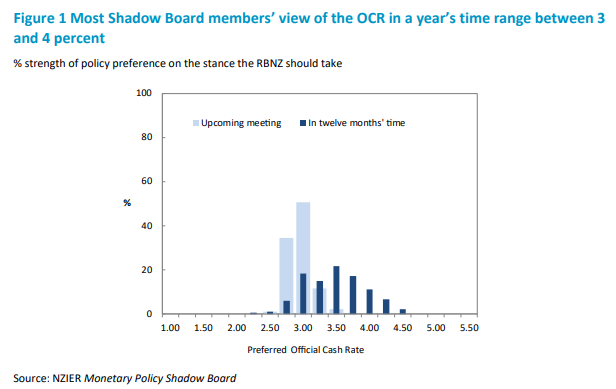
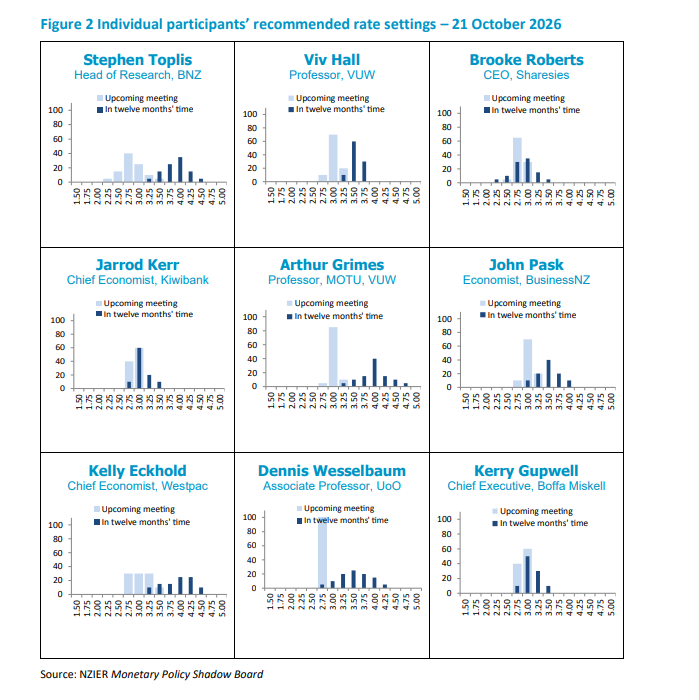
Table 1 Participant comments
Participants' comments are optional
| Stephen Toplis | Since September, oil prices have soared, the NZD has fallen, growth has surprised to the upside, and core inflation has remained elevated. Required response: raise the cash rate. |
| Viv Hall | There is little sign that, under recent and current monetary policy settings, looking through elevated global energy prices, a weak New Zealand dollar and key administered price rises is leading to CPI inflation returning sustainably to within the 1–3% band. A further 25 basis point increase in the OCR is therefore required now, both to lessen risks of second-round inflationary effects and increased inflationary expectations |
| Arthur Grimes | No comment. |
| John Pask | Given most indicators point to increased upside risks to inflation (including potential second-round effects of continuing fuel price hikes alongside a lower NZ dollar), the Reserve Bank will need to continue moving the OCR up towards more neutral levels (and perhaps beyond) over the coming months to keep inflationary expectations at bay. |
| Jarrod Kerr | • The RBNZ faces the same global uncertainty faced by many Kiwi businesses. Energy prices are a problem. Oil has spiked back into unwanted territory, and it’s tough to pass onto hypersensitive consumers. On the one hand, inflation is spiking again, and on the other hand, demand is being destroyed. And there’s no end in sight. • The RBNZ kicked off with a hawkish hike in July, followed by a dovish hike in September. It appeared the committee wanted to evaluate the damage done, following 50bps of hikes. The upcoming election is also looming large, consuming most of the local headlines of late. Many commentators believe the RBNZ will take a rest next week, before hiking again at the end of the year. • We prefer them to get it over and done with. They want 3%, so go to 3%. Hike next week if you must. But tell us that’s it for a while. Give us a prolonged pause. That will do more for business confidence than holding the sword of Damocles above our heads for another quarter. Take the threat of hikes away, and help our risk takers take risk. |
| Kelly Eckhold | There’s a good argument to slow the pace of interest rate increases now some tightening has occurred. While the short-term inflation picture seems more threatening the medium-term outlook hasn’t shifted. The CPI due later this week could show resurgent second round pressures, although there’s no sign of this from business and consumer surveys. I remain confident interest rates will be significantly higher in a year, but there is no need to rush to those settings while the labour market remains cyclically weak. |
| Dennis Wesselbaum | Demand remains weak but shows signs of improvement, while supply-side cost-push shocks are driving current inflation. This creates a monetary-policy trade-off: if supply shocks prove more persistent than expected, further OCR increases may be warranted. However, if fuel and related costs (plus rates) explain most of the inflation rise, core inflation is stable or falling, expectations remain anchored, and demand and wages are weak, the RBNZ should allow existing tightening to work and reassess as new evidence emerges. |
| Kerry Gupwell | For me it’s still a finely balanced call, but I lean towards another small increase in the OCR to 3%. The economy remains relatively soft, which for me argues for holding, even though inflation is still too high. Some of the recent inflation pressure reflects higher oil prices and a weaker New Zealand dollar rather than domestically generated inflation, so I think we need to be careful not to overreact. The difficulty is that, with the continuing conflict in Iran, these pressures may not prove as temporary as we would want them to be. The upcoming inflation figures will be important. If underlying inflation is easing, I’d favour holding; if it remains persistent, I think a small increase now would be sensible rather than risking bigger increases later. |
| Brooke Roberts | Hold at 2.75% now, with one final 25bp increase to 3.00% around year-end only if imported pressures persist — then on hold through most of 2027. The fuel shock has returned (petrol at record highs, NZD sharply weaker), but expectations are demonstrably anchored and labour-market slack keeps growing, so the case for pre-emptive further tightening is weak. |
About the NZIER Monetary Policy Shadow Board
NZIER’s Monetary Policy Shadow Board is independent of the Reserve Bank of New Zealand. Individuals’ views are their own, not those of their respective organisations. The next Shadow Board release will be on Monday, 7 December 2026, ahead of the RBNZ’s Monetary Policy Statement. Past releases are available from the NZIER website: www.nzier.org.nz.
Shadow Board participants put a percentage preference on each policy action. Combined, the average of these preferences forms a Shadow Board view ahead of each monetary policy decision.
The NZIER Monetary Policy Shadow Board aims to:
• encourage informed debate on each interest rate decision
• help inform how a Board structure might operate
• explore how Board members could use probabilities to express uncertainty.
For further information, please contact:
Ting Huang, Senior Economist
ting.huang@nzier.org.nz, 027 266 0969

Share this

Shadow Board is divided over a 25 or 50 basis-point cut in the OCR in October
Majority of Shadow Board members recommend a 25 basis-point OCR cut in October