
New Zealand Institute of Economic Research (Inc)
Media Release, 10 am Monday, 16 February 2026
For immediate release
The NZIER Monetary Policy Shadow Board recommends the Reserve Bank of New Zealand (RBNZ) keep the Official Cash Rate (OCR) at 2.25 percent in the upcoming February Monetary Policy Statement. Shadow Board members agreed that New Zealand’s economic recovery is starting to gain traction, but there remains a considerable degree of spare capacity in the economy, while headline inflation has increased. The general view was that the central bank should be cautious at this stage and wait for further data to assess how the economy will track over the coming months. One member pointed out that further easing in this monetary cycle risks entrenching inflation pressures.
Regarding where the OCR should be in a year, members’ views centred around 2.25 percent to 2.75 percent. This reflects the Shadow Board’s broad consensus that the RBNZ should commence raising the OCR in the second half of 2026. Members view that the OCR cuts to date will continue to work through the New Zealand economy over the coming year to provide the stimulus needed for a recovery, and the spare capacity will dissipate. One member noted that the RBNZ should closely monitor inflation expectations if economic momentum continues to build. Another member stressed that delaying OCR hikes risks OCR becoming too restrictive in the long run.
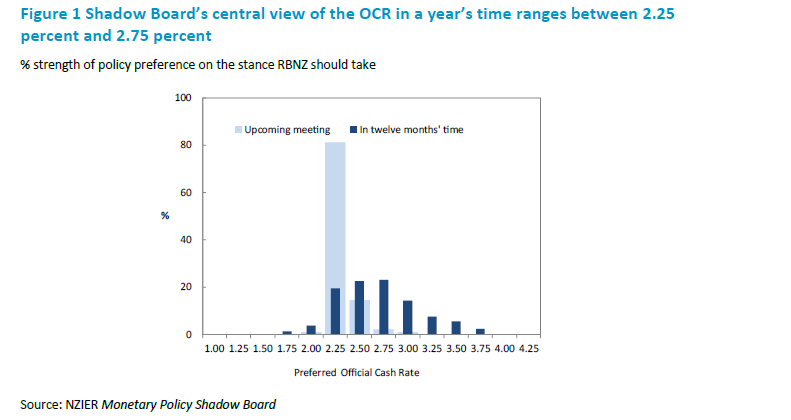
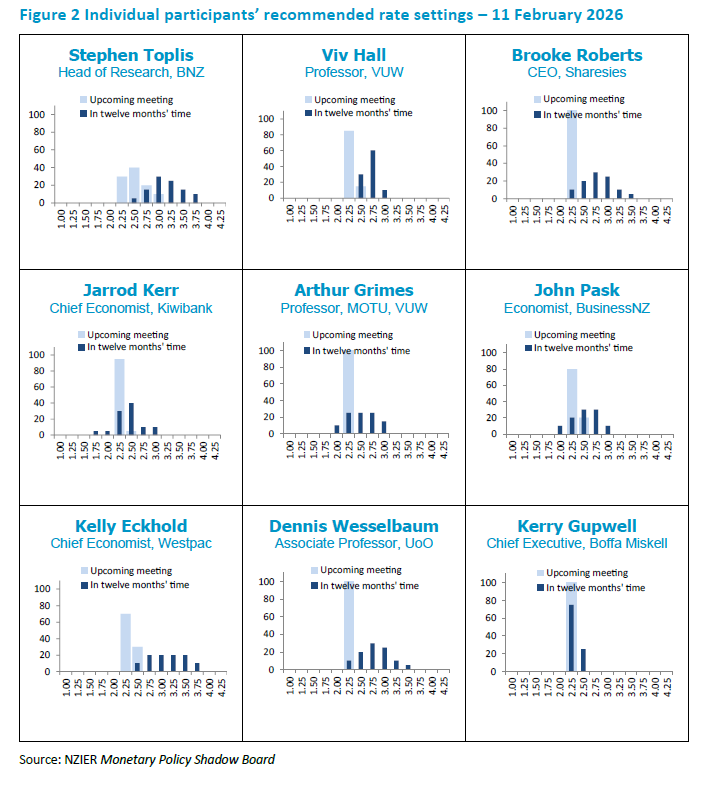
Table 1 Participant comments
Participants' comments are optional
| Stephen Toplis | Growth and inflation have proven stronger than expected and there is a mass of stimulus left in the system. The sooner that stimulus is reduced the greater the chance that the eventual move in interest rates will be modest. |
| Viv Hall | No comment. |
| Arthur Grimes | The data are showing both strengths and weaknesses. It’s best to ‘wait and see’ for a further 6 weeks at this stage before changing the rate. Over the next year, rates are likely to have to rise from their current low levels, given that the real interest rate when the OCR is at 2.25% is around zero. |
| John Pask | Inflationary expectations have risen while core inflation has yet to fall enough that the Reserve Bank should be all that comfortable with current settings. While there are both upside and downside risks to inflation, it is appropriate for the OCR to be put on hold for now. |
| Jarrod Kerr | We have seen a lift in confidence and some higher frequency data. This is good news. But it is far too early to be claiming victory on the recovery. There is still a long way to go. Inflation is frustrating, but so too is the weakness in the labour market, housing market, and large parts of the economy. Caution is warranted. Rate hikes are a story for very late in the year, probably next year. |
| Kelly Eckhold | Interest rates are highly stimulatory and it’s increasingly clear that the 75 bp of interest rate cuts adopted post-August 2025 were not required. Once confidence is attained that above trend growth is here to stay, then interest rates should be returned to neutral levels (3.75%). Right now, the degree of excess capacity and the likelihood of falling headline inflation allow time to assess. Undue delay will increase the chances of the OCR rising to 4% or beyond. |
| Dennis Wesselbaum | With CPI inflation at 3.1% and non-tradables inflation at 3.5%, and inflation expectations among households and firms still elevated, further easing risks entrenching inflation pressures. Growth is beginning to turn a corner, but spare capacity remains, and with past OCR cuts still working through the economy, the OCR should be held steady for now. |
| Kerry Gupwell | I don’t see a case for a change this month; I would hold at 2.25%. Activity is lifting, but it still feels tentative. If momentum continues to build, we will need to watch inflation expectations closely for signs that price and wage pressures are re-emerging. |
| Brooke Roberts | Keeping the OCR at 2.25% at the next meeting would provide continuity in monetary conditions as the economy continues to rebalance. With inflation pressures modest and growth indicators mixed, a pause allows further data to inform future decisions and reduces the risk of unnecessary policy volatility. |
About the NZIER Monetary Policy Shadow Board
NZIER’s Monetary Policy Shadow Board is independent of the Reserve Bank of New Zealand. Individuals’ views are their own, not those of their respective organisations. The next Shadow Board release will be on Tuesday, 7 April 2026, ahead of the RBNZ’s Monetary Policy Review. Past releases are available from the NZIER website: www.nzier.org.nz.
Shadow Board participants put a percentage preference on each policy action. Combined, the average of these preferences forms a Shadow Board view ahead of each monetary policy decision. The NZIER Monetary Policy Shadow Board aims to:
-
encourage informed debate on each interest rate decision
-
help inform how a Board structure might operate
-
explore how Board members could use probabilities to express uncertainty.
For further information, please contact:
Christina Leung, Deputy Chief Executive, Auckland
christina.leung@nzier.org.nz 021 992 985
or
Ting Huang, Senior Economist
ting.huang@nzier.org.nz 027266 090

Share this

Shadow Board recommends the Reserve Bank should keep the OCR on hold in February
Shadow Board recommends the Reserve Bank cut the OCR by 25 basis points in May